
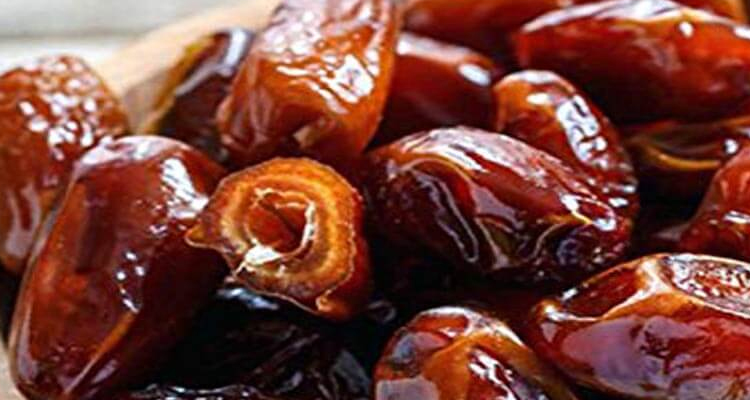
Ajwa Dates are a variety from Saudi Arabia, and one of the easiest to recognise on a tray. The fruit is small and roundish, near-black, with a finely wrinkled skin and a soft bite. Ajwa is one of several dates from the Madinah region, alongside Safawi and Mabroom. In Malaysia you will also see it sold as Kurma Nabi, which is a market name for Ajwa.
Areas where it grows
Ajwa comes from the Madinah area of Saudi Arabia. Its neighbours from the same region look quite different once you put them side by side. Safawi is longer than Ajwa, dark brown to black, soft and chewy. Mabroom is long and slender, reddish-brown and semi-dry. Ajwa stays the small, round, dark one of the group.
Most dates from the Gulf and the Middle East are harvested from late summer into autumn, and new-season stock reaches Malaysia some weeks after that.
Findings of the dates
The Ajwa dates have been studied in the laboratory, and some of that work looks at what the fruit is made of.
A 2019 study by researchers at King Saud University and a Riyadh hospital, published in the Journal of Food Biochemistry, analysed Ajwa and reported that the dates contain substantial amounts of carbohydrates, energy, potassium, iron, polyphenols and flavonoids.
A 2018 study by researchers at Universiti Putra Malaysia and the Islamic University in Madinah, in the Journal of Food Science and Technology, compared five commercial varieties using NMR spectroscopy:
- Ajwa, Safawi and Ambar from Madinah
- a date from Bam in Iran
- Deglet Noor from Tunisia
The varieties separated clearly by their chemical makeup. All of the Madinah dates contained phenolic compounds, while Deglet Noor had more sucrose and fructose than the other four, which the authors linked to its distinctive sweet taste.
Two newer papers looked at Ajwa extracts in more detail. A 2025 study from Taibah University in Madinah, published in the Saudi Medical Journal, ran an Ajwa extract through liquid and gas chromatography and identified 17 metabolites, mainly flavonoids, phenolic acid derivatives, fatty acids and sugar derivatives. A 2026 paper by researchers in Ismailia, Egypt, profiled a methanol extract of Ajwa by mass spectrometry and described a complex composition rich in phenolic acids, flavonoids, vitamins and minerals.
All four studies are laboratory work. The 2019 one gave an Ajwa extract to rats, and the 2018 one analysed fruit samples and tested them on cells. The two newer ones worked with extracts, tested in rats or in cell culture. None of them looked at people eating whole fruit. This research tells you about the date’s composition, not what a few Ajwa a day will do for your health, so read headlines about “miracle” results with care.
Choosing Ajwa
Choose Ajwa for what it is: a small, soft, dark date with a look nobody mistakes for Medjool or Deglet Noor. If you want to compare it with Safawi, Medjool or Deglet Noor, the shop lists those too. For the current Ajwa listing, go straight to Ajwa dates.
This article is general food information and not medical advice.